

Through our bovine business, ABS, we help customers drive genetic improvement through their herds, in line with their commercial goals. Our first beef-on-dairy Life Cycle Assessments (LCAs) have now quantified the reduction in greenhouse gas (GHG) emissions intensity from this genetic improvement.
Studies in both the UK and US have demonstrated that animals sired by elite Beef InFocus sires, powered by ABS NuEra Genetics, lead to higher growth rates, reduced inputs, enhanced feed conversions and a measurable reduction in GHG emissions intensity in beef-on-dairy production.
In the UK study, the reduction ranged from as much as 4.7% to 8.8% compared to industry average genetics. In the US study, the reduction was up to 4.6% compared to industry average genetics. Both studies used real-world records collected from over 60,000 beef-on-dairy animals in commercial systems.
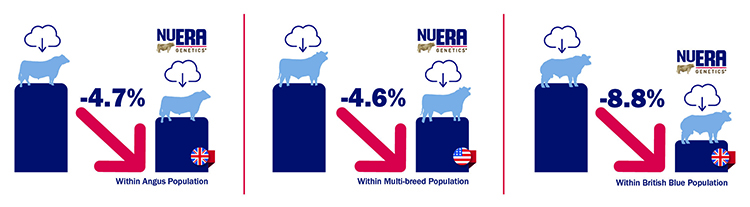
Developed according to International Standards Organization (ISO) specifications, the ISO-conformed LCAs were externally validated by panels of experts.
The studies demonstrate the vital role that genetics play in lowering environmental impact and materially improving sustainability across the beef supply chain. Genetic improvement is a long-term solution for sustainability. The impact of genetics delivers permanent and cumulative benefits for farmers and the supply chain, whilst also improving productivity and profitability.